Carte blanche
The Three MusketeersCarte blanche is a blank or broadly discretionary authorization whose danger lies in the gap between its formal wording and the acts it permits. In the hands of Cardinal Richelieu, it becomes a portable state of exception: a document that can make violence appear lawful after the fact, place its bearer beyond ordinary accountability, and turn political judgment into an instrument of personal revenge. Its capture by Athos and transfer to d’Artagnan reverse that power, allowing the threatened men to survive the machinery that Milady and Richelieu have set in motion.
Definition and Political Function
The expression belongs to a world in which police power already operates through concealed arrest and collective entrapment. The mousetrap is described as a system that secretly detains a suspected person, places armed men in ambush, admits everyone who knocks, and closes the door behind them until nearly all the establishment’s regular visitors are under control. Carte blanche extends the same logic beyond a single house: instead of suspending liberty through a hidden arrest, it authorizes an individual to act first and justify the action through the state afterward.
Its political force depends on ambiguity. The document does not merely command one specified act; it gives its holder room to decide what the “greatest good of France” requires. That language allows private intention to borrow the prestige of public necessity. The authorization is therefore both a practical weapon and a rhetorical shield: it transforms an unexamined decision into an alleged service to the state.
Milady’s Authorization
Richelieu provides the decisive carte blanche to Milady after discussing the danger posed by the Duke of Buckingham and the need to find a woman willing to avenge herself upon him. Milady does not ask for a narrowly defined assignment. She requires an order that will ratify beforehand everything she may judge proper to do for the greatest good of France. Richelieu accepts the request, and Milady confirms that the woman capable of carrying out the task has already been found: herself.
The exchange reveals the document’s real function. Milady is not simply an agent receiving instructions; she seeks immunity for decisions whose details she will determine alone. The authorization grants her a legal-looking envelope for acts that may include eliminating enemies and removing obstacles. Richelieu’s willingness to issue it shows how political expediency can absorb personal vengeance without openly acknowledging the absorption. The state does not merely employ violence; it delegates the interpretation of necessity to a dangerous subordinate.
Athos Takes the Paper
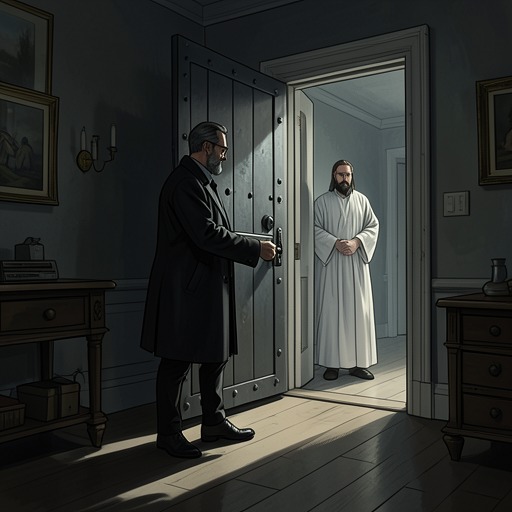
Athos confronts Milady and invokes the document as the price of her immediate submission. Recalling the terrible history that binds them, he draws a pistol, cocks it, and holds it almost against her forehead. He demands that she deliver the paper signed by the cardinal or face death. Milady’s terror leaves her barely able to produce a human sound, yet she knows that Athos is not bluffing. As the trigger is about to be pulled, she reaches into her bosom, draws out the paper, and hands it over with a curse.
The scene makes the carte blanche a physical object at the center of a struggle over who may command whom. Milady has possessed institutional protection, but Athos temporarily replaces that protection with direct personal coercion. Once he has the paper, he lowers the pistol, approaches the lamp, and verifies the document rather than trusting appearances. The threat has changed the balance of power: the authorization that allowed Milady to act against others now becomes evidence capable of protecting those she intended to destroy.
The document bears the date December 3, 1627, and states that, by the cardinal’s order and for the good of the state, the bearer has done what she has done. Its wording is strikingly retrospective. It does not describe a future act or establish a clear limit; it validates conduct already performed and leaves the bearer’s conduct undefined. The carte blanche thus functions as advance absolution, a written conversion of unknown violence into state service.
From Threat to Safeguard
Athos preserves the paper and brings it to the other three companions. When d’Artagnan asks whether the carte blanche remains in Milady’s hands, Athos answers that it has passed into his, though not without difficulty. He keeps the original in the pocket of his uniform, and d’Artagnan unfolds it with a trembling hand. Aramis recognizes it as an absolution according to rule, while d’Artagnan initially believes that its very existence may amount to a sentence of death for him.
Their disagreement over what to do with it gives the object two opposing meanings. D’Artagnan wants it destroyed because he sees the cardinal’s signature as proof of the power arrayed against him. Athos insists that it must be preserved carefully and values it more highly than gold. To d’Artagnan, the paper recalls arbitrary execution; to Athos, it is the material guarantee that can obstruct execution. The contrast captures the document’s central paradox: its authority is terrifying precisely because it is real, but that same authority can be redirected against the person who issued it.
The paper also consolidates the companions’ loyalty. Athos’s seizure of it is not a private victory over Milady alone; it becomes a means of protecting d’Artagnan and perhaps all four men from a power that could dispose of them without ordinary trial. The document passes from an individual agent to a fellowship, and its value becomes collective rather than merely personal.
Richelieu’s Counter-Commission
The carte blanche reaches its final and most surprising use when d’Artagnan presents it to Richelieu as a safeguard. The cardinal recognizes his own handwriting and reads the dated authorization slowly, dwelling on each syllable. He then considers d’Artagnan’s courage and resourcefulness, as well as the crimes and dangerous genius of Milady. Her removal has relieved him of a perilous accomplice, while d’Artagnan appears to him as a young man whose abilities could serve a better master.
Richelieu tears up the paper that d’Artagnan has surrendered. The gesture seems at first to destroy the young man’s only protection and to restore the cardinal’s complete freedom to punish him. Instead, Richelieu writes upon a parchment, seals it, and gives d’Artagnan another carte blanche. The new document is a lieutenant’s commission in the Musketeers, with the name left for d’Artagnan to enter himself. The blank space no longer authorizes uncertain violence against enemies; it opens a recognized military future for the person who has survived that violence.
This reversal changes the value of the expression without making its political danger disappear. Richelieu does not renounce discretionary power. He demonstrates that he still controls it, choosing whether to condemn d’Artagnan or promote him. The same authority that could have exposed the young man to trial now grants rank and official standing. D’Artagnan responds by kneeling and declaring that his life belongs to the cardinal, while also arguing that Athos, Porthos, and Aramis are more deserving. The new authorization therefore binds him to the political order even as it rewards the loyalty that has repeatedly placed him in conflict with that order.
Meaning and Narrative Significance
Carte blanche joins the novel’s recurring oppositions between law and force, public duty and private vengeance, and formal authority and personal courage. The document’s language claims to serve France, but its immediate bearer is Milady, whose actions are driven by lethal hostility and whose methods make the distinction between state service and revenge unstable. The authorization exposes a political system in which ordinary procedures can be bypassed whenever a powerful figure declares an exceptional necessity.
At the same time, the paper is not simply a symbol of oppression. Once Athos takes it, the instrument of exception becomes an instrument of defense; once Richelieu tears it apart, he recreates its form as a commission. The object travels through three hands and undergoes three transformations: it begins as Milady’s immunity, becomes the companions’ safeguard, and ends as d’Artagnan’s advancement. Each transformation preserves the underlying principle that written authority can alter a person’s status instantly.
The expression also clarifies the relationship between speech, writing, and action in the political world of the novel. Richelieu’s authorization does not merely describe what has happened. It performs a legal and political act: it declares that the bearer’s conduct was ordered and beneficial to the state. Yet its force depends on recognition by those who read the signature and seal. Athos verifies it, d’Artagnan presents it, and Richelieu both acknowledges and replaces it. Carte blanche is therefore power made portable, but never wholly independent of the institutional figure whose name gives the blank permission its force.